Simulated Monolithes
Artist Peter Repetti stages the three pieces of Jean-Louis Marchand's Monolithes — his solo renditions of Steve Reich — as three worlds of light. Each film records a single, uninterrupted performance of a simulation: a world that knows its recording by heart, so that light arrives with the sound — and sometimes just ahead of it. Nothing was filmed and nothing was drawn; everything visible was grown from the music — a constructed synesthesia, in which every event of light has its cause in sound. Reich built these works from processes — two identical lines slipping out of phase, a rhythm assembled one note at a time, a canon of eleven clarinets — and the images are built the same way: not illustrations of the music but parallel processes, run at the music's speed.
L'artiste Peter Repetti met en scène les trois pièces du Monolithes de Jean-Louis Marchand — ses versions solo de Steve Reich — comme trois mondes de lumière. Chaque film enregistre une exécution unique et ininterrompue d'une simulation : un monde qui connaît son enregistrement par cœur, si bien que la lumière arrive avec le son — et parfois juste avant lui. Rien n'a été filmé, rien n'a été dessiné ; tout le visible a poussé de la musique — une synesthésie construite, où chaque événement lumineux a sa cause dans le son. Reich a bâti ces œuvres à partir de processus — deux lignes identiques qui se déphasent, un rythme assemblé note à note, un canon de onze clarinettes — et les images sont bâties de même : non pas des illustrations de la musique, mais des processus parallèles, menés à la vitesse de la musique.
The work enters a long history of visual music — an art shaped by the desire to give musical experience a visible form: Scriabin's light score for Prometheus: Poem of Fire; Oskar Fischinger's charcoal-on-paper Studies, animated frame by frame and synchronized to gramophone records in the early 1930s; Mary Ellen Bute's visual symphonies, among the first films with electronically generated imagery; John Whitney's computed harmonies of motion. It keeps company, too, with the stages that minimalist music built for itself — Robert Wilson and Philip Glass's architectural weave of image, light, and music in Einstein on the Beach; Anne Teresa De Keersmaeker dancing the Piano Phase duet with Michèle Anne De Mey in Fase; and the video operas Beryl Korot made with Reich himself, The Cave and Three Tales. The dancers of the first movement owe their one named debt to OpenEndedGroup's Loops, an abstract digital portrait of Merce Cunningham drawn from motion capture of his hands, its tracked joints becoming the nodes of a fluctuating network. Here, by contrast, no body was recorded; the figures are generated through chance procedures — a signature Cunningham method — given joints and let loose among the pillars, legible only by inference. And from the Light and Space artists the work keeps one conviction, learned in their rooms: that light, space, and the viewer's perception can themselves constitute the work.
L'œuvre s'inscrit dans une longue histoire de musique visuelle — un art façonné par le désir de donner à l'expérience musicale une forme visible : la partition lumineuse de Scriabine pour Prométhée ou le Poème du feu ; les Études d'Oskar Fischinger, fusain sur papier, animées image par image et synchronisées sur des disques au début des années 1930 ; les symphonies visuelles de Mary Ellen Bute, parmi les premiers films à imagerie générée électroniquement ; les harmonies de mouvement calculées de John Whitney. Elle tient compagnie, aussi, aux scènes que la musique minimaliste s'est bâties — le tissage architectural d'image, de lumière et de musique de Robert Wilson et Philip Glass dans Einstein on the Beach ; Anne Teresa De Keersmaeker dansant le duo Piano Phase avec Michèle Anne De Mey dans Fase ; et les opéras vidéo que Beryl Korot a créés avec Reich lui-même, The Cave et Three Tales. Les danseurs du premier mouvement doivent leur seule dette avouée à Loops d'OpenEndedGroup, portrait numérique abstrait de Merce Cunningham issu de la capture de mouvement de ses mains, dont les articulations suivies deviennent les nœuds d'un réseau fluctuant. Ici, par contraste, aucun corps n'a été enregistré ; les figures sont engendrées par des procédures de hasard — méthode signature de Cunningham — dotées d'articulations et lâchées parmi les piliers, lisibles seulement par inférence. Et des artistes du Light and Space, l'œuvre garde une conviction apprise dans leurs salles : que la lumière, l'espace et la perception du spectateur peuvent à eux seuls constituer l'œuvre.
Among its contemporaries — Ryoji Ikeda's data-saturated black rooms, Refik Anadol's machine-dreamed volumes, the raymarched worlds of the shader-art community — Simulated Monolithes is distinguished by its obedience. It invents no data and consults no network; its structure is dictated by scores now half a century old, and by one musician's decision to play every voice himself. The single sanctioned disobedience belongs to the dancers, who ignore the music's phrasing entirely — as Cunningham always insisted dance and music should meet only in the same room. Where generative art tends toward the endless, this work is as long as the music, and ends when it ends.
Parmi ses contemporains — les salles noires saturées de données de Ryoji Ikeda, les volumes rêvés par machine de Refik Anadol, les mondes en raymarching de la communauté du shader art — Simulated Monolithes se distingue par son obéissance. Il n'invente aucune donnée et ne consulte aucun réseau ; sa structure est dictée par des partitions vieilles d'un demi-siècle, et par la décision d'un musicien de jouer lui-même toutes les voix. La seule désobéissance autorisée appartient aux danseurs, qui ignorent entièrement le phrasé de la musique — Cunningham a toujours soutenu que la danse et la musique ne devaient se rencontrer que dans la même pièce. Là où l'art génératif tend vers l'infini, cette œuvre dure aussi longtemps que la musique, et finit quand elle finit.
The whole work is one program: a single WebGL fragment shader, about fifteen hundred lines of code, that computes every pixel of every frame from mathematics alone. Space is described as signed distance fields and rendered by raymarching; light, reflection, and atmosphere are gathered along each ray. Before anything plays, the recording is decoded in full and analyzed: its strikes are found, ranked by loudness and brightness, the pulse measured, the loudness arc of the whole piece mapped. The visuals consume that event stream against the audio clock — deterministic to the sample. The first two films were rendered offline, one exact frame at a time at a constant 60 frames per second (2560 × 1440); the third is a recording of the simulation running live, in real time. The sound in each film is the original recording itself.
Toute l'œuvre est un seul programme : un unique fragment shader WebGL, environ mille cinq cents lignes de code, qui calcule chaque pixel de chaque image à partir des seules mathématiques. L'espace est décrit en champs de distance signée et rendu par raymarching ; lumière, reflets et atmosphère sont accumulés le long de chaque rayon. Avant toute lecture, l'enregistrement est décodé en entier et analysé : ses frappes sont repérées, classées par intensité et par brillance, la pulsation mesurée, l'arc dynamique de la pièce entière cartographié. Les visuels consomment ce flux d'événements contre l'horloge audio — déterministe à l'échantillon près. Les deux premiers films ont été rendus hors ligne, image exacte par image exacte, à 60 images par seconde constantes (2560 × 1440) ; le troisième est un enregistrement de la simulation tournant en direct, en temps réel. Le son de chaque film est l'enregistrement original lui-même.
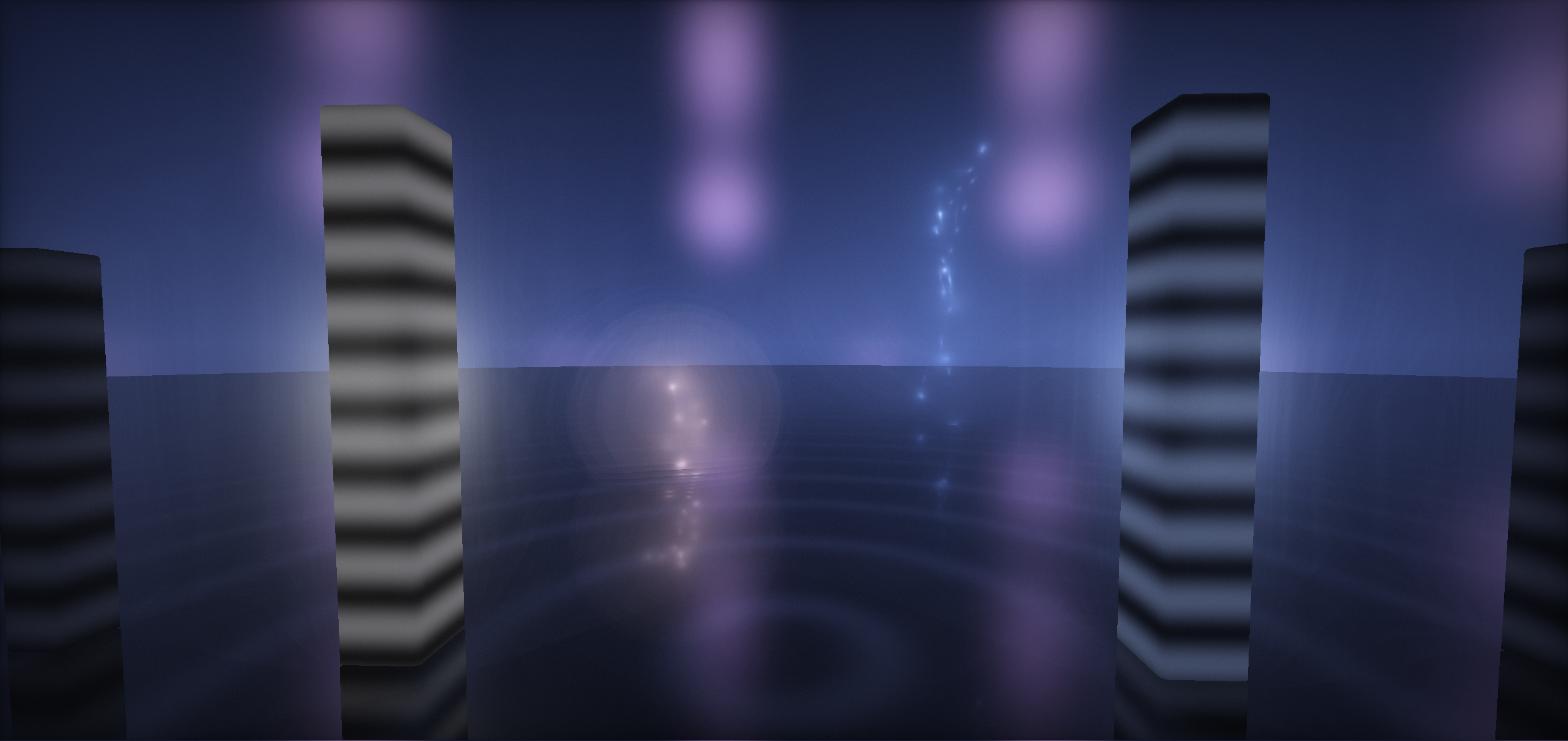
Twin Pillars — the two towers are twelve-key keyboards; each detected note strikes a key at the height of its brightness — the ear's stand-in for pitch — successive notes alternating tower to tower, as the two voices do. A slow drift process separates the voices as the pianists do, driving the moiré gratings of the sky, the interference curtain between the towers, and two wandering ring systems on the floor whose phases slip against each other. Each completed cycle of the phase leaves an echo pillar behind. The dancers are driven by chance procedures in the Cunningham sense — joints easing to random targets on time-warped clocks that burst and rest — drawn only as constellations of light joined by a re-stringing cat's cradle, after OpenEndedGroup's Loops. The palette turns from candlelight-and-moonlight to forest-green-and-saffron out of the great unison flash a third of the way through.
Piliers jumeaux — les deux tours sont des claviers de douze touches ; chaque note détectée frappe une touche à la hauteur de sa brillance — l'équivalent, pour l'oreille, de la hauteur de note — les notes successives alternant d'une tour à l'autre, comme le font les deux voix. Un lent processus de dérive sépare les voix comme le font les pianistes, animant les moirés du ciel, le rideau d'interférences entre les tours, et deux systèmes d'anneaux errants au sol dont les phases glissent l'une contre l'autre. Chaque cycle accompli du déphasage laisse derrière lui un pilier-écho. Les danseurs sont mus par des procédures de hasard au sens de Cunningham — des articulations glissant vers des cibles aléatoires sur des horloges au temps distordu, entre rafales et repos — dessinés seulement comme des constellations de lumière reliées par un jeu de ficelles sans cesse retendu, d'après Loops d'OpenEndedGroup. La palette passe de chandelle-et-clair-de-lune à vert-forêt-et-safran au sortir du grand éclat à l'unisson, au tiers de la pièce.
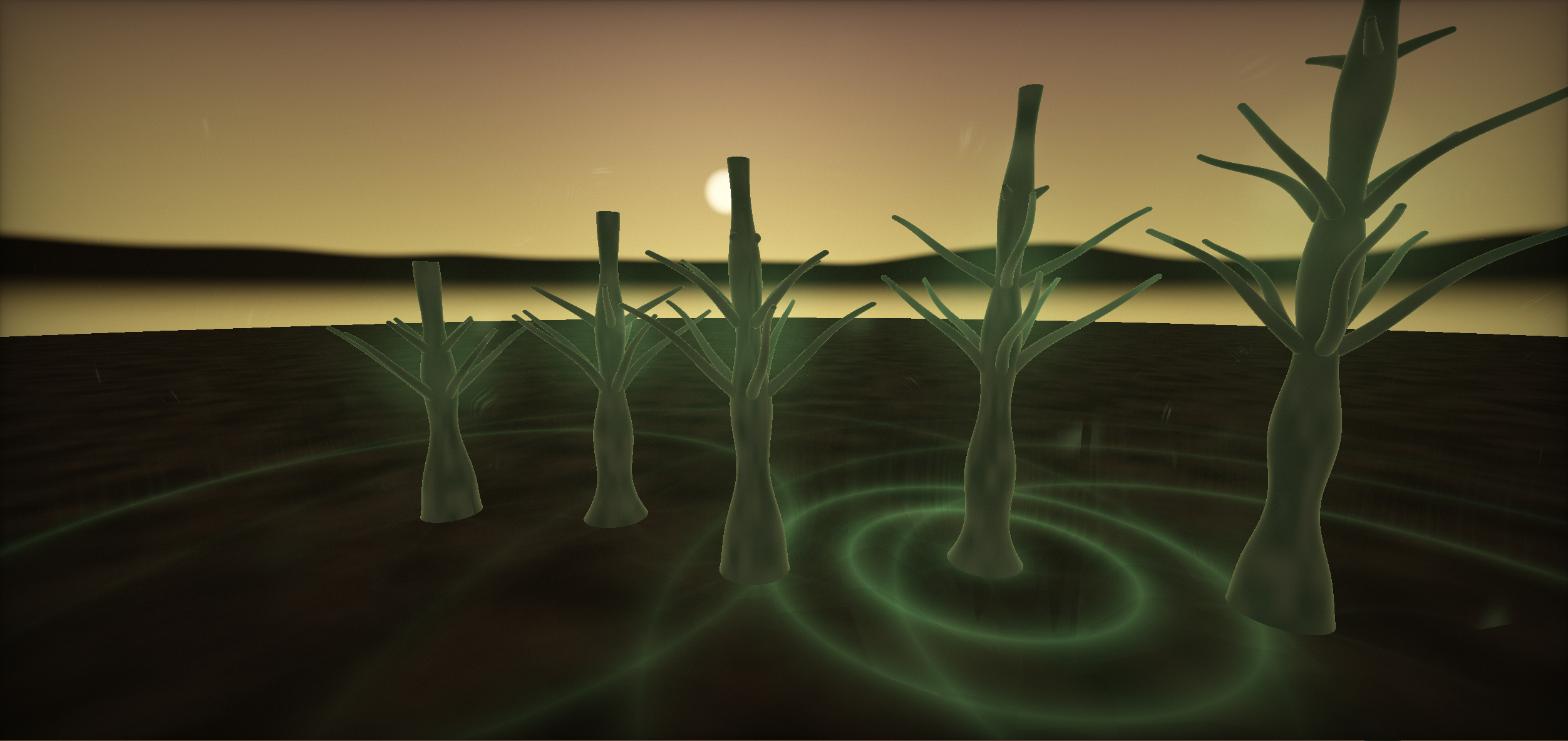
The Grove — five trees are grown strike by strike as distance fields: trunk, then whorls of branches, unlocked by the music's own accumulation. Blue rain falls volumetrically and pools around the seeds. Midway, the camera passes under the soil into a second world — mirrored root-trees and a mycelial web of noise-threads through which every strike propagates as a light wave between the root systems — before surfacing into a sudden daybreak. At the felling, each tree morphs geometrically into cut timber; the ring faces are concentric bands whose colors record the film's own history, rain-ivory at the pith to red-earth at the rim, and every strike still ripples outward through them.
Le Bosquet — cinq arbres poussent frappe par frappe, en champs de distance : tronc, puis verticilles de branches, déverrouillés par l'accumulation propre de la musique. Une pluie bleue tombe en volume et s'accumule autour des graines. À mi-parcours, la caméra passe sous le sol dans un second monde — arbres-racines en miroir et toile mycélienne de fils de bruit, où chaque frappe se propage comme une onde de lumière entre les systèmes racinaires — avant de refaire surface dans une aube soudaine. À l'abattage, chaque arbre se change géométriquement en bois coupé ; les faces de coupe sont des anneaux concentriques dont les couleurs consignent l'histoire du film lui-même, ivoire de pluie au cœur, terre rouge au bord, et chaque frappe y ondule encore vers l'extérieur.
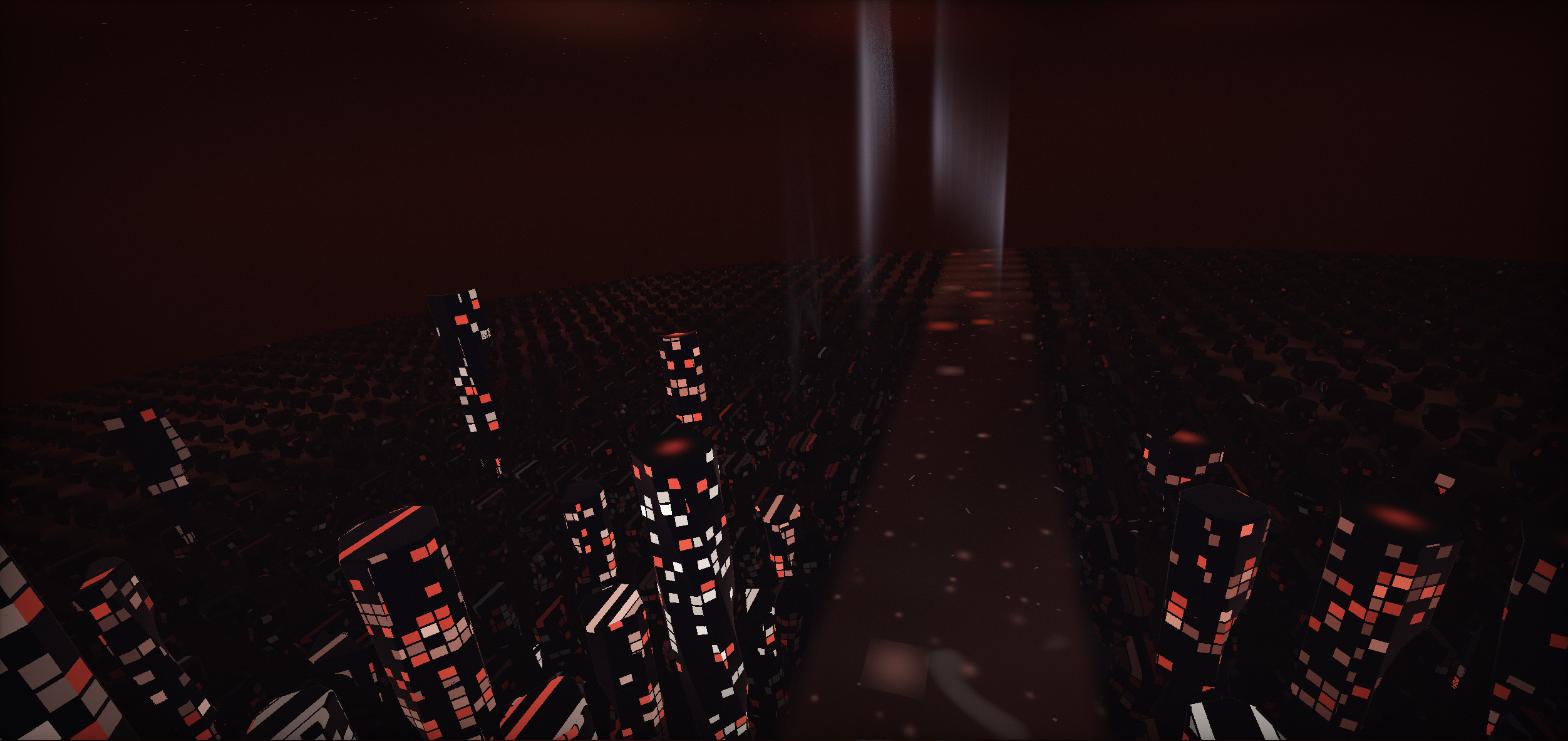
The City — the towers are a procedural grid, each cell swelling and twisting on its own phase; windows light by interlocking canon, and each note pulses a district near the flight path. When the camera passes inside a tower, one of six hidden rooms renders instead. In the slow middle movement the riverfront goes dark while windows deep in the grid — dark the rest of the piece — wake in the distance; afterward the light comes home. From the final quarter, crimson gathers window by window into the red ending. The river is never water: it is sheets of drifting stars that learn to mirror the sky as the piece opens up.
La Ville — les tours sont une grille procédurale, chaque cellule enflant et se tordant sur sa propre phase ; les fenêtres s'allument en canon imbriqué, et chaque note fait battre un quartier proche de la trajectoire de vol. Quand la caméra traverse une tour, l'une de six pièces cachées se révèle à la place. Dans le lent mouvement central, la rive s'éteint tandis que des fenêtres enfouies dans la grille — sombres tout le reste de la pièce — s'éveillent au loin ; puis la lumière rentre chez elle. À partir du dernier quart, le cramoisi s'amasse fenêtre par fenêtre jusqu'à la fin rouge. Le fleuve n'est jamais de l'eau : ce sont des nappes d'étoiles dérivantes qui apprennent à refléter le ciel à mesure que la pièce s'ouvre.
Peter Repetti is a bio-visual artist who works primarily in the medium of increasingly precise sentences. He does not paint, does not sculpt, and has never personally illuminated a single pixel; he describes, rejects, and describes again — the method of a frustrated artist who has spent a lifetime in the audience. Simulated Monolithes has never been exhibited at MASS MoCA, but it has been imagined there in great detail, apparently. He lives and works on the same Wi-Fi network as the piece.
Peter Repetti est un artiste bio-visuel qui travaille principalement dans le médium de la phrase de plus en plus précise. Il ne peint pas, ne sculpte pas, et n'a jamais personnellement allumé le moindre pixel ; il décrit, rejette, et décrit encore — la méthode d'un artiste frustré qui a passé sa vie dans le public. Simulated Monolithes n'a jamais été exposé au MASS MoCA, mais il y a été imaginé dans les moindres détails, paraît-il. Il vit et travaille sur le même réseau Wi-Fi que l'œuvre.
Steve Reich published by Boosey & Hawkes · recordings by Jean-Louis Marchand
Steve Reich publié par Boosey & Hawkes · enregistrements de Jean-Louis Marchand